



What We Can Learn from History’s Greatest Design Disruptors
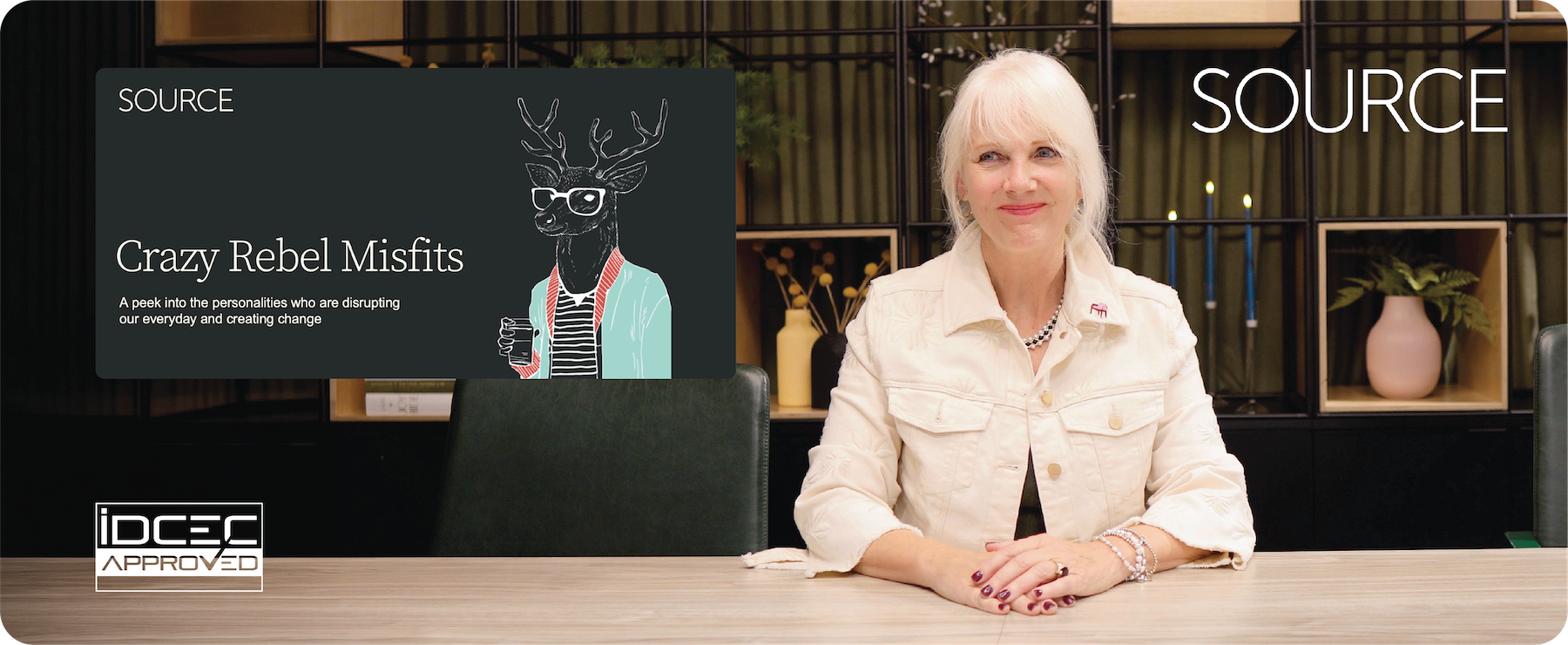
When you think of a risk-taker or a disruptor in the design world, what traits come to mind? Fearless? Defiant? Bold? We often label these individuals as “crazy,” “rebels,” or “misfits,” but in Crazy Rebel Misfits, Bethany Parks from Source International argues that these aren’t negative terms. Instead, being a misfit is about embracing total authenticity, originality, and self-awareness to push the boundaries of what is possible.
Throughout history, the architecture and design industries have been propelled forward by people who refused to accept the status quo. By studying these design disruptors, we can learn how to maximize our own creative potential and rethink how we build our teams.
The Resilient Visionary: Buckminster Fuller
Not all disruptors start with instant success. Buckminster (Bucky) Fuller is a prime example of a genius who had to fail his way to greatness. Expelled from Harvard twice and having faced devastating personal tragedies, Fuller was relentless in his desire to change the world. He imagined metal houses that could be dropped into neighborhoods by helicopters and designed a three-wheeled aerodynamic minivan in 1933 that tragically flipped over and caught on fire during a demonstration. Despite these massive failures, his dedication to creating structures with the least amount of material possible eventually led to his claim to fame: the geodesic dome.
The Rule Breaker: Zaha Hadid
Sometimes, disrupting an industry simply means refusing to play by its fundamental rules. Born in Baghdad in the 1950s, Zaha Hadid dedicated herself to thinking outside the boundaries of traditional architecture. She famously refused to design on a 90-degree angle, earning her the title of the “Queen of Curves”. Her visionary approach to structures—often featuring impossible-looking swoops and holes—made her the first woman to win the prestigious Pritzker Architecture Prize in 2004.
The Restless Innovator: Philippe Starck
A true disruptor never stops evolving. Philippe Starck began his career designing opulent hotel interiors in Paris before shifting to “democratic design,” creating accessible, everyday items like tape dispensers and toilet bowl cleaners for Target. Today, in his 70s, his brain is still spinning with non-stop ideas. He is currently designing interiors for the Axiom Space Station and partnering with software companies to pioneer the “AI Chair”—setting the parameters and letting artificial intelligence generate the final product.
The Imaginative Hybridizer: Bjarke Ingels
What happens when a kid who wanted to be a cartoon artist and grew up playing Minecraft becomes an architect? You get revolutionary concepts like “hedonistic sustainability”. Instead of just replicating the boring, boxy buildings of the past, his firm believes in merging desirable elements that seem mutually exclusive. This led to one of his most notable projects: combining a waste treatment plant with a fully functional ski slope, proving that sustainable design can also be a radically fun destination.
Disruption Requires Self-Awareness
While it is easy to look at these towering figures and simply see “genius,” their success is deeply tied to emotional intelligence and authentic collaboration. Designing the future doesn’t happen in a vacuum. It requires teams of architects, contractors, manufacturers, and clients all “rowing in their boat” in the same direction.
To be a disruptor today, you must understand your own personality traits—perhaps through tools like the Enneagram—so you can build trust, minimize stress for your teammates, and harness your collective strengths. As organizational psychologist Adam Grant perfectly summarized: “Your personality matters, but your ability to adapt matters more. Who you become is not about the traits you have, it’s about what you decide to do with them”.
Here’s to the crazy ones, the rebels, and the misfits. They are the ones who change things, and they are the ones who push the human race forward.
Keep Learning, Earn CEU Credit
In the Crazy Rebel Misfits, Bethany Parks of Source International leads a one-hour exploration of the rebels and innovators who reshaped design and business. Through stories of daring architects and entrepreneurs, the course reveals how authenticity and individuality can spark creative collaboration and lasting impact.
 Profile
 Certificates
 My Courses
 Settings